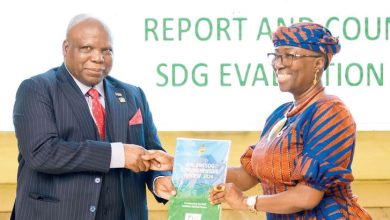
The World Bank Group has hailed youth-led agribusiness cooperative Acades as a model for transforming Malawi’s smallholder farming into a catalyst for job creation, export growth and higher rural incomes.
Speaking after a tour of Acades operations at Mpingu in Lilongwe on Monday, World Bank Group regional vice-president for Eastern and Southern Africa Ndiame Diop said the cooperative is a tangible example of what the country’s agricultural future should look like.

Acades is a youth-led social enterprise by five young graduates, who have built a thriving soya beans enterprise that now supplies both local and regional markets, demonstrating what coordinated youth innovation can achieve when supported by strong partnerships.
Diop said the cooperative exemplifies “the power of visionary leadership” and shows that Malawi’s young people are the leaders who do not have to wait for the future to exercise leadership.
He observed that Acades’ success, organising farmers, aggregating production, improving seed systems and investing in processing, represents the kind of transformation Malawi needs to tackle poverty on a large-scale.
Said Diop: “For the World Bank, agriculture is essential, particularly for countries like Malawi where a large share of the workforce depends on farming. Without higher agricultural productivity, it is impossible to raise incomes and reduce poverty.”
He explained that the bank has recently launched a global initiative called AgriConnect designed “to support agriculture in a different way” by backing farmer cooperatives, de-risking private investment and using digital technology to link smallholders to finance, inputs, and markets.
Through AgriConnect, the World Bank seeks to bridge the gap between policy-level investment and practical implementation, something Diop said is already evident in Acades’ operations.
In his remarks, Acades chairperson Hastings Nhlane said World Bank support has been instrumental in transforming what began as a youth idea into a functioning agribusiness platform.
He said: “We are investing in agriculture through our collective efforts as young people, producing, aggregating, exporting and supplying various agricultural products.
“We have received significant support from the World Bank, which funded these high-quality facilities through a matching grant. We now also have electricity and improved road access.”
Nhlane said these interventions, implemented through Malawi Government and the World Bank projects, have helped Acades overcome major barriers facing the youth.
Speaking at the same event, Minister of Agriculture, Irrigation and Water Development Roza Mbilizi said the cooperative embodies government’s ambition to place young people and women at the heart of commercial agriculture.
“This country has many capable young people and without government support, it will not progress. A project like this clearly demonstrates what our youth can achieve. What they need is our support from government and all partners, including donors,” she said.
Mbilizi urged development partners to invest more directly in universities such as the Lilongwe University of Agriculture and Natural Resources and Malawi University of Business and Applied Sciences to ensure that graduates are “ready to start businesses” in fields such as mechanisation, seed production and value addition upon graduation.
With Malawi’s population dominated by the youth and more than 70 percent of its workforce engaged in agriculture, according to National Statistical Office.